Dear [FIRST_NAME]: The Template That Killed My Response Rate
I remember the exact moment I thought I'd finally cracked the code.
It was a Tuesday night. I had just finished crafting what I believed was the perfect outreach email template. Every word was deliberate. The subject line was punchy. The opening hook referenced their company name—pulled automatically from a merge field. The value proposition was crystal clear. The call-to-action was impossible to ignore.
I loaded 500 prospects into my spreadsheet, triple-checked the merge fields, and hit send.
Then I waited.
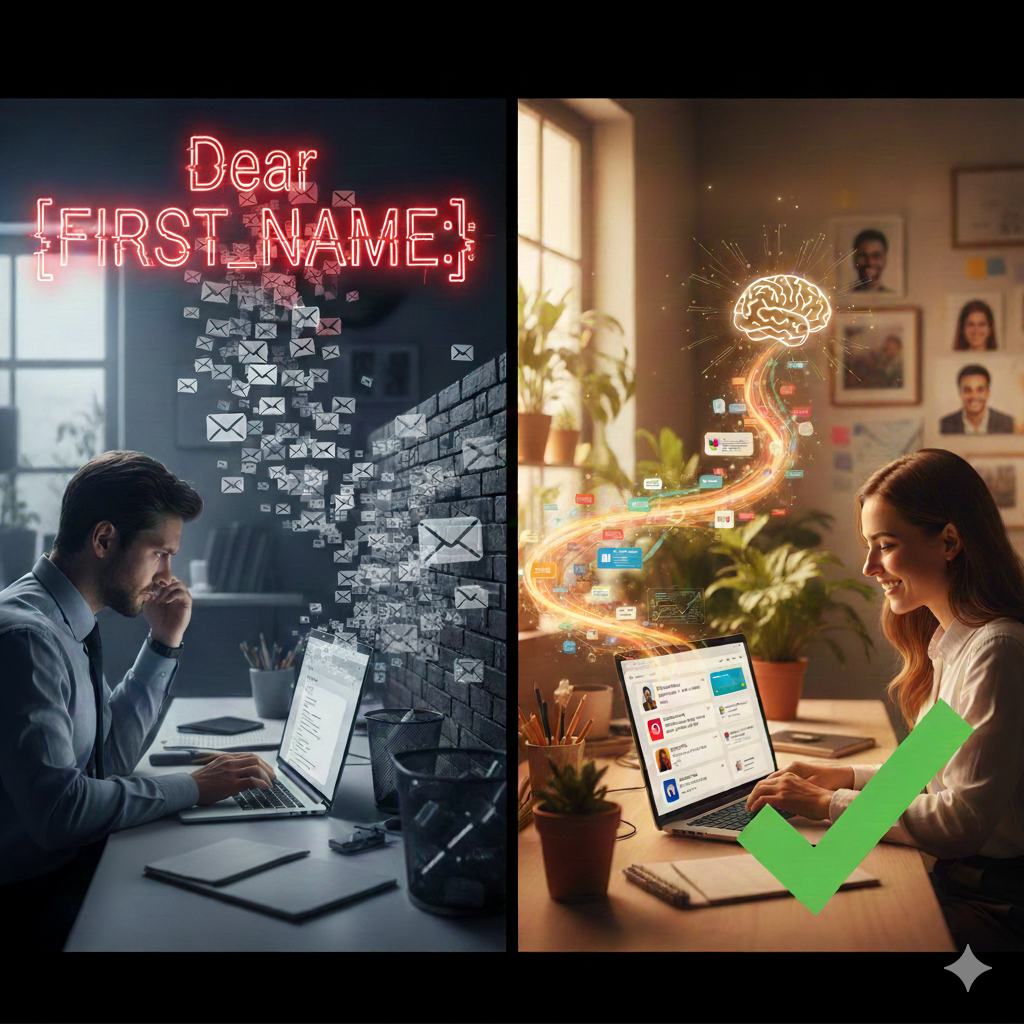
The Silence Was Deafening
The first hour, nothing. Normal. The second hour, still nothing. By day two, I had exactly three responses:
- "Please remove me from your list."
- "Unsubscribe"
- An auto-reply from someone on vacation
Three responses out of 500 emails. A 0.6% response rate—and two of them were people telling me to go away.
I stared at my inbox, refreshing obsessively, as if checking more frequently would somehow conjure replies into existence. It didn't. The silence just grew louder.
The Uncomfortable Truth
Here's what I couldn't admit to myself at the time: my "perfect" template was garbage. Not because the writing was bad—it was actually pretty good. But because it was obviously, painfully, insultingly templated.
"I love what you're doing at [COMPANY_NAME]" fools exactly no one. Every recipient knew, within the first three seconds of scanning my email, that I had sent the exact same message to hundreds of other people. And why would anyone respond to that?
Think about it from their perspective. They're busy. Their inbox is a warzone. They receive dozens of cold emails every week from people trying to sell them something. And here comes another one that starts with a hollow compliment and a merge field that screams "you're just a row in my spreadsheet."
The worst part? I had become exactly the kind of marketer whose emails I delete without reading.
The Template Trap
I fell into what I now call the Template Trap. It goes like this:
- You need to reach more people than you can possibly email individually
- You create a template to "scale" your outreach
- You add merge fields to make it feel "personal"
- Recipients instantly recognize it as automated
- Your response rates crater
- You blame the template and write a new one
- Repeat steps 2-6 forever
The trap isn't in any specific template—it's in the entire approach. You can't "personalize" your way out of automation. Swapping [FIRST_NAME] for their actual name doesn't make an email personal. It makes it an automated email with slightly better mail merge.
What Actually Works
Real personalization isn't about inserting their name correctly. It's about demonstrating that you've actually done your homework. That you understand their specific situation. That you're reaching out to them, not to "anyone who fits this demographic."
The emails that get responses reference something specific:
- A recent blog post they wrote
- A product feature unique to their business
- A challenge that's obvious from their website
- Something that proves you spent more than zero seconds learning about them
But here's the problem: doing that kind of research for every single prospect is impossible at scale. You can't spend 15 minutes reading someone's website before sending every email—not if you need to reach hundreds or thousands of people. (And if you're still struggling to find prospects in the first place, check out our guide to breaking through the invisible wall.)
At least, you couldn't. Until recently.
The AI Difference
What changed everything for me was realizing that AI could do the research I didn't have time for. Not fake personalization—real context.
Imagine if, before sending each email, an AI could:
- Read the prospect's website
- Understand what they actually do
- Identify relevant talking points
- Craft an opening that references their specific situation
That's not a template with better merge fields. That's an email that actually demonstrates you give a damn.
The first time I tested this approach, my response rate jumped from under 1% to over 12%. Not because I became a better writer overnight—but because each recipient could tell, instantly, that this wasn't spam. It referenced their business. It mentioned something from their website. It felt like a message from someone who had actually looked at what they do.
Kill Your Templates
If you're still sending templated outreach with merge fields and wondering why no one responds, I get it. I was there. It feels efficient. It feels scalable. It feels like the "smart" way to do outreach.
But efficiency that produces zero results isn't efficiency—it's waste. You're not saving time by sending 500 emails that no one reads. You're burning time, burning your reputation, and training recipients to ignore you.
The fix isn't writing a better template. The fix is killing templates entirely and embracing AI that does the personalization work for you—not fake personalization, but real context that makes each message feel like it was written for that specific person.
Because in a world drowning in automated outreach, the emails that feel human are the only ones that get read.